What a stranger finds when looking for a church
A census of 4,699 congregations across three American evangelical denominations.
Rob Hughes · Aeris Labs · August 2026 · Aggregate findings, no church or denomination named.
We took a full census of three American evangelical denominations and found 4,699 churches in their directories. Where a church had a website, we examined it to see what a visitor would find. A congregation can meet every Sunday and still be unfindable on the web.
Most of these churches come through fine. The directory lists them, the link works, and a stranger who goes looking arrives where they meant to. What follows is about the ones where that breaks, and about the working websites that still leave a visitor without answers.
congregations examined across three denominations
directory links lead nowhere a visitor can use
likelier to have no website when the congregation worships in another language
Where to start
If you are in a regional or denominational office
- Finding One — One directory link in ten leads nowhere
- Finding Two — List maintenance determines what strangers find
- Finding Three — A fifth of these churches have no website at all
- Finding Four — Language predicts whether a congregation can be found
If a church’s website is your responsibility
Pastor, board, outreach, volunteer or whoever ended up with the password.
- Finding Five — Six sites in a thousand say what they are, where, and when
- The check — Ten minutes to check your own front door
If you want to check our work
- The limits of what we could measure — why every minority language figure is a floor
- Method — how every figure on this page was produced
We chose three denominations that are alike, on purpose.
Studying multiple denominations reduces the influence of any one, so a pattern that appears in all three is not due to one office's habits. We chose three that are alike because the more they have in common, the fewer explanations are left when they differ.
They do differ on real things, but inside a narrow band. They read the same scriptures the same way, send students to overlapping seminaries, sing the same songs on a Sunday, cooperate on the same mission fields, and would recognize one another's members without much fuss. A family moving towns might cross from one to another and mostly notice the parking.
They fare differently online, by a factor of three. The differences point to administration: how each keeps its records, and whose job that is.
Across all three: 4,699 congregations, 22% with no website listed, 87% of listed links working, 10% leading nowhere, 52% publishing structured data. The three do not sit together on every measure — dead links ran from 5% to 18%, congregations with no website from 11% to 34% — and Finding Two is about that spread.
How to read the numbers on this page
Anything stated plainly, without attribution, we measured ourselves. We took each denomination's own public church directory in full and followed every website it lists. Every site got an identical set of checks, scored by one shared definition, so the three studies can be compared and added together. The full method is at the foot of this page.
Because we checked every congregation rather than a selection, these are counts and not estimates, and they carry no margin of error. There are two limits instead: what a directory happens to know, and what a machine can see from outside. Both are stated where they bite.
Anything we did not measure is attributed in the sentence that uses it, by name and by year. Where a widely repeated statistic could not be traced to a published method, we left it out rather than pass it along.
We build websites for churches for a living, which is a reason to check our work rather than to take it on trust. Everything here is either a citation you can follow or a count produced by the method at the foot of this page, which anyone can run against any set of denominational directories. We do not name the three we chose, and directories change week to week, so these exact numbers are not reproducible. The method and the shape of the result are.
One directory link in ten leads nowhere.
Almost nobody arrives at a directory by accident. A stranger with no history starts at Google or an AI assistant. The people who open a directory already know the name of the denomination: a family moving across the country, a pastor sending someone on, somebody raised in the tradition and looking for it again in a new town. They use the official directory because of the name they know and trust.
Across all three denominations, 367 of 3,651 listed links — one in ten — lead nowhere a visitor can use. Expired addresses. Pages removed. Sites that stopped answering years ago. Placeholder pages left by a hosting company after an account lapsed. The listing still looks authoritative, but it is no longer accurate. The ordinary name for this is link rotWhen links stop working because addresses change, sites move and accounts lapse. Nothing about the link looks broken until somebody clicks it.Read the full entry →.
Type a town, get a congregation, follow the link. Every part of that sequence has to hold for a directory to work, and the link is the part that drifts and breaks over time. Somebody at a church changed its website address and forgot to tell the denominational office three states away. Nothing on either end announces the break, and the only person who finds the problem is the visitor looking for a church.
Nothing requires a denomination or regional body to publish a directory of its churches. But whoever publishes one owns what it says.
What happens when you follow 3,651 directory links
We followed every listed website in three denominations, and tried each apparent failure a second time.
We did not take the first pass as the answer. Automated checks can get refused for innocent reasons: one site turns away unfamiliar visitors, one answers too slowly to look alive, one has a security certificate that the test distrusts but browsers accept. For each apparent failure, we tried again in a different way, and about a third came back alive; those are not in the number above.
Some of these addresses answer perfectly well, but are not churches any more. A hosting company's "domain parkedA web address that still answers but has nothing of yours behind it: a hosting company’s placeholder, an advertising page, or a notice that the account has closed. Everything about it works. None of it is yours any more.Read the full entry →" placeholder. A page saying the account has been deactivated. An empty shell with nothing on it. Every naive automated check counts those as working sites, and we did too until we looked at them by hand. They are the failures that look like success: nothing is broken, and nothing is there.
Nothing about finding these was difficult. We followed links a directory already publishes, from outside, with no access to anything private, and most failures gave themselves away in under a second. No judgment was required to tell a dead address from a live one. The check is trivial. Nobody is running it.
List maintenance determines what strangers find.
Two of the three denominational directories had badly decayed, so we expected the third to be the same. To our surprise, it had only 5% dead links against 18% in the worst of the three. That is better than three times healthier. Whatever causes link rot, it is not inevitable.
They also differ in what they attempt. One directory carries a pastor's name for nearly nine congregations in ten and a regional body for every single one; the other two record neither.
For anyone reading this from a denominational office: the gap in directory quality tracks how well the lists are maintained, as we show below. We can only see what each region achieved and not what it had to work with.
Two of the three denominations record which regional body each congregation belongs to, so we can ask what the national average hides. It hides almost everything.
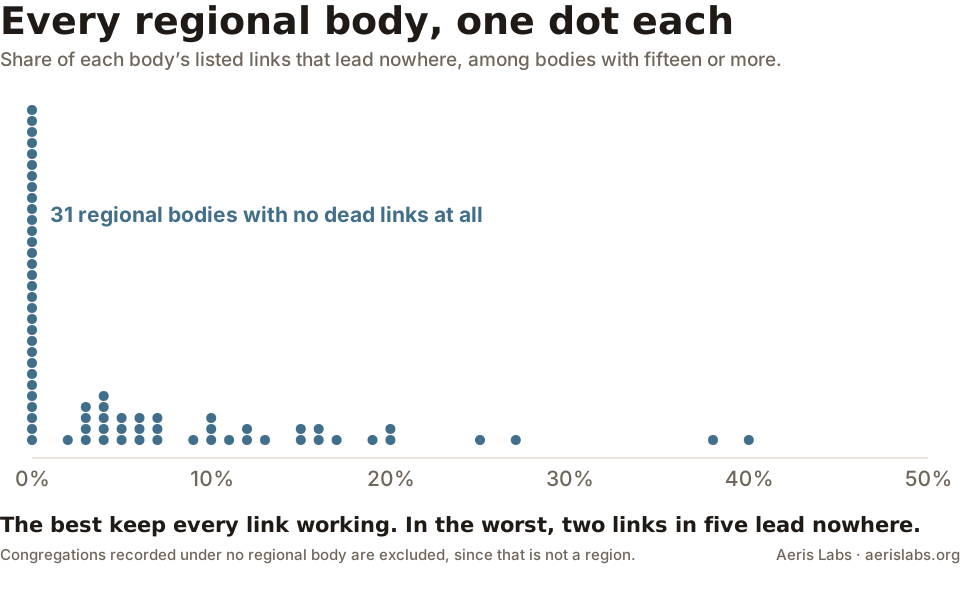
Half of the qualifying regional bodies in one denomination are perfect. The typical region in the other is at one in five. These are the same country, the same decade, the same web, and in a good many towns, churches a few streets apart.
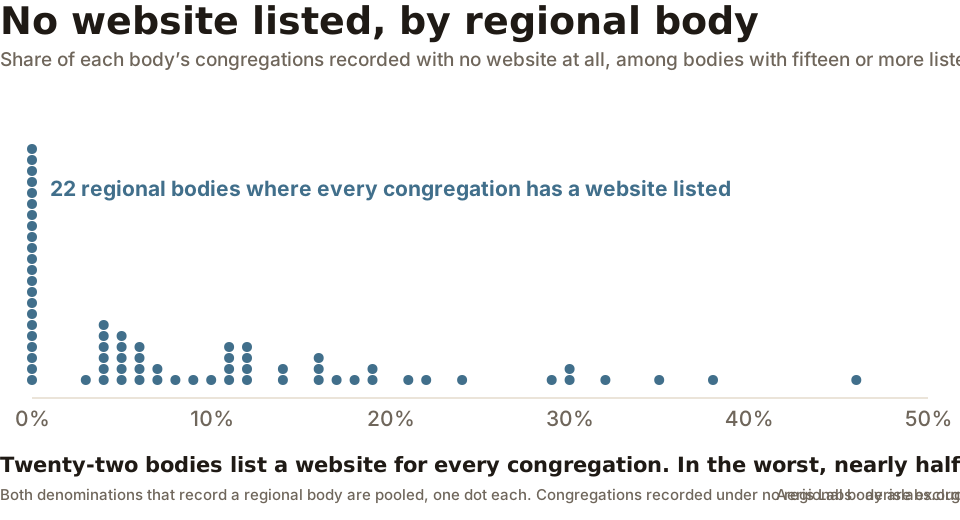
Within a single denomination the range is threefold: 38% of links dead in its worst region against 12% in its best, under one national office and one piece of directory software. Congregations with no website listed at all follow the same shape, from 35% in one of its regions to 11% in another, and from 46% down to nothing across the regions of the other denomination. Ranges here skip the smallest regions, which one church can move ten points: both cover regions with at least fifteen listed links.
Region predicts how well a congregation can be reached.
In one region we could check the national directory against the region's own list, church by church. A fifth of that region’s congregations were missing from the national list entirely, not listed with a bad link, simply absent. Fewer ran the other way, and nobody reconciles the two. We could not repeat the check elsewhere, because most regional bodies publish no list a machine can read.
A directory exists so that a stranger looking for a church finds one. In thirty-one regional bodies, every link in the directory leads where it says. Nothing outside the office watches these links, so a broken one stays broken until someone inside looks.
Whoever clicked the link went back to the results and picked the next church.
A fifth of these churches have no website at all.
1,048 of 4,699 congregations are listed in their denomination's directory with no website whatsoever. We hand-checked a sample of them: an entire region of one denomination and a random draw from the rest of the country.
About a third of the churches recorded as having no website actually have one. Real ones. Sites on platforms like Church Center and Faithlife, a Korean-language congregation, one church with its own phone app. No one ever updated the directory, or whatever record it was generated from.
Lists publish links to churches that are gone, and stay silent about churches that are right there.
The two thirds that genuinely have no website divide almost evenly. One group has nothing findable at all. No web page. No directory listing. Nothing. Several of these congregations have been meeting for fifty years, and the web has no idea they are there. The other group lives on Facebook, which gets a section of its own, below.
Pew Research Center asked Americans who had looked for a new congregation how they went about it. In 2016, 37% had searched online — 47% among those whose search was within the previous five years, and 59% among adults under thirty. That is the most recent citable data we could find, but the rate was increasing during Pew's own study period.
A congregation with no website is not necessarily hidden or failing. It is reachable by anyone who already knows it exists, and for a church that grows through word of mouth in a tight-knit community, that may cost very little. For a church hoping to be found by someone new in town, having no website is a problem.
We could find no published count of how many American congregations have a website, but it would not be hard to measure. There is one census big enough to have answered this: Faith Communities Today put 180 questions to 15,278 congregations in 2020. It asked about livestreaming and online giving. Not one of the 180 questions asked whether a congregation had a website.
Our own figure of 1,048 congregations, or a little over a fifth of the total, has nothing to compare it against, so we cannot tell you whether these three denominations are typical. Further study of more denominations would provide the answer.
As far as we can tell, no one has published a count of church websites like this: three complete denominational rosters, with every listed site followed. The method is below for anyone who wants to repeat it. Please tell us about any other research on church websites that you know about.
Two of fifty Facebook pages publish a service time.
Roughly a third of the congregations with no website live entirely on a Facebook page. That is a reasonable choice made by reasonable people: the tool is free, the congregation already uses it, posting a service time takes ten seconds, and it plainly works. The photos are warm, the comments are real, the community is there. We are not going to tell a church to leave.
Facebook against a website is the wrong fight. These are two different parts of the same house, and a church needs both. A website is the front door: indexable, linkable, controllable, open to anyone who walks up. A Facebook page is the visiting room, where people who are already inside talk to each other. A visiting room is a wonderful thing to have. It is a poor thing to put your address on.
What a church's Facebook page hands to a search engine
Sign out of Facebook, open one, and read what actually arrived. We did it for all fifty in our hand-checked sample.
| Pages that loaded normally | 50 of 50 |
|---|---|
| Median size of the Facebook page delivered | 937 KB |
| Median readable text inside it | 48 characters |
| Pages stating a service time a machine could read | 2 of 50 |
The login wall we expected was not there, and what came through in its place turned out to matter more: fifty pages that open perfectly well, look exactly as they should, and contain almost nothing a person or a machine could read. Nearly a megabyte arrives, and the only human-readable words in it are the name at the top. A crawler gets the name and the town. The service times are on that page, in front of anyone with eyes, and the crawler never sees them.
Facebook also decides who may look. Its published instructions to automated visitorsA plain text file, always at yoursite.com/robots.txt, telling search engines and other crawlers what to read and what to skip. A mistake here can stop them reading your site at all.Read the full entry → work as a guest list: twenty-six crawlers are named and admitted — Google, Bing, DuckDuckGo, LinkedIn and, when we checked, the main AI assistants — and everything not named is refused outright. Who is on that list is Facebook’s decision and revisable at any time, and no church on the platform has a say in it.
From inside Facebook, the audience feels larger than it is. Around seven in ten American adults use Facebook at all: 71% by Pew Research Center's 2025 national survey, 68% of Americans twelve and over by Edison Research in January 2026. Taking the more conservative reading, close to three in ten adults are not on the platform in any form, and only about half of all adults open it on a given day.
Why it looks sufficient from the inside
A Facebook page can be warm and active while at the same time still not reaching anyone new.
Pew's 2025 survey finds presence remarkably flat across ages: 68% of adults under thirty use Facebook, against 80% of those thirty to forty-nine and 57% of those sixty-five and over. What is not flat is primacy. Edison Research's Infinite Dial 2026 puts Facebook as the platform used most often by 40% of American social media users, and dominant among those fifty-five and older.
Younger adults have Facebook accounts. In the same Pew survey, 80% of under-thirties use Instagram and 95% use YouTube, both ahead of Facebook's 68%.
If you are over fifty-five and your church’s Facebook page looks busy, you are reading your own generation correctly, but not the rest of the town.
The people already in the pews are on Facebook. The twenty-eight-year-old family that moved in last month is on a map app and a search box.
What a website does that nothing else can
The address is yours to move. Domain names are rented rather than owned, and they renew on a date. But the lease is yours and it travels: you can rebuild the site, change hosts, change platforms, even change the church's name, and everyone already pointed at you still arrives. The sign, the bulletin, the directory entry, years of search results. A Facebook page is permission you are granted, and permission does not travel. The most serious findings in this study, the ones we will not publish, are congregations that lost their domain name.
You can publish facts a machine can read. Service times, address, denomination, and contact details in a form search engines can lift directly into results. Just over half the working church websites in this study publish any structured data at all. Two of the fifty Facebook pages state a service time anywhere a machine can read it.
Everyone is allowed in. No allowlist, no account, no algorithm deciding who sees the notice. A social media post reaches the fraction of followers the platform chooses to show it to, that week, for its own reasons. A page on your own website is there for anyone who looks, indefinitely.
You control whether it can be used. Whether a screen reader can navigate it, whether it works on a slow phone, whether it is in the languages your congregation actually reads. On someone else's platform those are settled for you, and mostly not in your favor.
Both, then. The Facebook page carries the week: the potluck photos, the Wednesday cancellation. The website carries the address, the service time, and the stranger who has never heard of you. Asking the visiting room to be the front door is the one arrangement that fails.
A caution against the obvious conclusion
It would be convenient for us to end this section with "so every church needs a website." We build websites. Take the recommendation with the appropriate discount, and take this with it: a good website does real work, but a mediocre website does little.
Our own numbers say most of these church websites are mediocre. Of the websites that work, barely half publish anything a machine can read directly, a third of homepages carry fewer than two hundred words, and 348 still display a copyright year of 2024 or earlier. A church that puts up a thin, stale, unreadable site and considers the problem solved has bought another thing to neglect.
What a working front door looks like
- Findable by search and AI.
- Accurate about when and where you meet.
- Readable by a screen reader and a slow phone.
- In the languages your people read.
- At an address the church controls.
Most church websites do not manage all five of these, and managing them is worth far more than simply having a website. The checklist further down is the free version of exactly that standard.
Language predicts whether a congregation can be found.
Sort every congregation by the language its name points to, and a divide opens. Among churches with English or general names, 18% have no website listed. Among Spanish-named congregations, 64%. Among Khmer-named congregations, 91%.
Names are a crude instrument. We measured how crude, and the answer runs one way: it undercounts these congregations and understates the gap rather than inventing it. Every figure below is a floor.
These three denominations govern themselves differently and reached different immigrant communities, and the same language gap appears in all three. And unlike with dead links, it does not close where the records are best kept. Better records do not fix this one.
Congregations with no website listed
Pooled across all three denominations, by the language each church's name points to.
The gap holds inside each one separately, at three different baselines.
The same gap, three times over
Share of congregations with no website listed. Groups of fewer than ten congregations are not shown, because one church moves them ten points or more.
| One | Two | Three | |
|---|---|---|---|
| English / general | 18% | 28% | 10% |
| Spanish | 63% | 68% | 33% |
| Korean | — | 40% | 29% |
| Vietnamese | — | 62% | — |
| Multiple of the English rate | 3.5× | 2.4× | 3.3× |
One language group does better than the English majority
In the denomination with the worst overall rate, where 28% of English-named congregations have no website, Chinese-named congregations are at 8%: four out of forty-eight, three and a half times better than the majority.
All forty-eight sit in the same denomination as the English-named congregations they outperform, and they are the best-represented group in the study.
So the website gap is not the price of speaking another language. Nothing we measured explains why this one group came out ahead: not the platform, not the quality of their sites, which are slightly worse than average.
Among the congregations that do have a working site, most quality measures are close to everyone else's. One is not: reading the pages rather than the names, minority-language sites carry a stale copyright year 40% of the time against 27% for English.
One denomination let us check this properly. It sorts some congregations into language-based regional bodies rather than geographic ones, so we could use its own classification instead of guessing from names. Two hundred and seven congregations sit in those bodies: 42% have no website against 8% elsewhere in the same denomination, and their links fail at 19% against 4%.
Both gaps are roughly fivefold, and they fall on the same congregations one after the other: 98 of the 207 can be reached from the directory at all, 47% against 88% everywhere else in that denomination.
This is not a deficiency of these congregations. When we hand-checked a comparable group, we went in expecting dormancy: churches winding down, a website nobody had needed for years. That is not what came back.
We found a congregation preparing to celebrate its thirty-fifth anniversary. One claiming, plausibly, to be the first church of its denomination on its island. These are not dying churches. They teach English on weeknights, post videos every Sunday, and celebrate their fiftieth anniversaries — and none of them are listed with a website in their denominational directories.
The fingerprint of a fight with the tools
Looking at the non-English websites these congregations do have, a particular signature keeps appearing. The welcome, the sermon titles and the ministry descriptions are in Korean, or Spanish, or Vietnamese, written by someone for their own community. The navigation and every button are in English: Home, More, Read More.
The English words are left over from the template. The same default is in the markup: of the 2,459 homepages that declare a languageA declaration at the top of a page’s code saying which human language it is written in. Screen readers use it to choose a voice and a pronunciation; browsers use it for spellcheck, hyphenation, and whether to offer a translation.Read the full entry → at all, only 47 declare anything other than English, which is the line a screen reader reads to decide what voice to speak the page in.
The tools are capable. Every major platform can be fully translated, navigation included. Doing it just requires knowing which settings exist, and on a do-it-yourself website builder there are a great many, all optional and none prompted. Somebody building their fourth English church site would never notice they were there. Twenty years of website tooling has made a church website easy and cheap in English and left everything else an advanced topic.
The non-English congregations we studied are some of the most distinctive in their denominations. They are also the least likely to be found on the web by people looking for exactly them, and the least served. No other gap between congregations in this study is this wide. If there is a single place where good work could do the most good, it is here.
Six sites in a thousand say what they are, where, and when.
Set aside every broken link and look only at the 2,865 sites that answered a second time. The basics are good, and mostly due to the do-it-yourself website builders that host many of these sites. Nearly all read well on a phone and are served securely. Everything a visitor can check is in order, but everything that decides whether they turn up is not.
What the working sites are missing
Start with the plainest case. Forty-two of these sites tell search engines not to list them at all. The instruction is a single word: noindexA single instruction in a page’s code, or in the reply from its server, telling search engines not to list it. Nothing about the page looks any different, and the page itself goes on working perfectly.Read the full entry →. Every builder has a switch that writes it, meant for the weeks before launch, and nothing on the finished page shows whether anyone switched it off. One setting in the wrong position keeps a church out of every search.
Measured on the sites that answered a second time. Pooled across the three denominations, which moved together on every measure. Higher is better.
Nearly half of these sites carry no structured dataA small block of code in a page that states what you are, where you are and when you are open, in a form search engines read without guessing. Those facts can then appear in search results themselves, not just a link.Read the full entry →, the small block of markup that lets a search engine show a church's service times and address directly in results instead of just a link. The vocabulary is not Google's private invention: it is maintained jointly by Google, Bing, Yandex and Yahoo, and it contains a type for a church, which inherits a field for the hours it is open. Four search engines agreed a church should be able to publish when it meets. Google's own guidance is written in terms of eligibility — without the required properties, a page is not eligible for the enhanced result. It is missing from 1,368 church websites.
A third of homepages carry fewer than two hundred words. What kind of church is this? What is a Sunday morning like? Would I be out of place? Two hundred words is not enough to answer any of that, and it gives a search almost nothing to match against whatever someone typed.
The study cannot say why homepage content is often so thin. In our own work with churches, the two explanations we observe are that nobody was sure what to write, and that the page was designed to look good before anyone decided what it needed to say.
Two measures decide what a blind visitor gets. Almost a third of these sites have no main heading at all, and only 40% keep a clean heading structure, which is the map a screen reader uses to move through a page. Four sites in five carry at least one image with no description. To a screen reader, those images are not there at all.
348 working sites show a copyright year of 2024 or earlier. 130 read 2020 or before, and 28 are frozen in 2020, the year everything stopped. The oldest reads 2003. Every one of those sites was answering requests when we checked.
A website can outlive the congregation that made it. Lifeway Research counts about four thousand Protestant churches closing in the United States each year — 4,500 in 2019, 4,000 in 2024, against roughly as many opening. No one takes the website down. The domain renews on a credit card someone set up years ago, so the host keeps answering, and the footer holds the year that someone last touched it. For some share of these 348, the date is accurate. It is the same reason directories keep listing churches that are not there.
Nearly a quarter of these sites arrive as a bare link when a member shares them. Social preview tagsA few lines of code in a page naming the title, description and image to use when somebody shares your link. Most apps read them to turn a pasted address into a preview card with a headline and a picture.Read the full entry → are what most apps read to decide what a link becomes: a title, a sentence and a photograph, or an address on its own. 77% of these sites carry them. The rest look plainest at the very moment somebody is recommending them.
About one site in four declares no canonical addressThe address you name as a page’s real home, stated in the page’s own code, for when the same content can be reached at several addresses. It asks a search engine to treat that one as the original.Read the full entry →, the line naming which version of a page is the real one when several answer. When the canonical address is missing, the search engine picks for itself. It might pick the domain you used before a rename, or the default your website builder handed you. Neither is what is printed on your sign.
Three sites in ten load at least one image, font or script over an insecure connectionWhen a secure (HTTPS) page loads an image, font, or script over an insecure (HTTP) connection. Browsers block the risky kinds outright and stop treating the rest of the page as fully secure.Read the full entry →. Only one stray file is enough for a browser to stop treating the page as fully secure. Most browsers now block the file rather than fetch it in the clear, so what a visitor sees is a photograph that never appears. The certificate is valid and the server is configured correctly, but the page is downgraded anyway.
The platform decides
What American churches actually build on
Identified platform across all working sites in the three studies.
The general-purpose tools have won. Squarespace, WordPress and Wix account for more church websites between them than every church-specific platform combined, several times over. The market built for churches is a minority of the churches.
We expected the shortfalls above to be spread evenly, because they look like the kind of thing individual churches get wrong. On the single measure that most determines whether a church's service times can appear in results at all, the range between builders runs almost the whole scale.
By platform, among builders with at least forty sites in the study.
The uncomfortable part is which platforms sit at which end. The general-purpose website builders do this automatically. The platforms built specifically for churches mostly do not. Squarespace and Wix publish structured data on every site we measured, without the customer ever knowing the word. Subsplash and Tithely — church platforms, sold to churches, for church purposes — publish it on three percent and two percent respectively.
This is not incapacity. Subsplash sets a search description on every site it hosts and a sitemap on 97% of them: the automated work is being done, and done well. What it does not emit is the one block of markup naming the organization as a church, giving an address, and stating when it meets — the three facts its customers exist to publish. The capability is demonstrated on every other measure.
Platforms sold to churches are not using standard fields built for churches.
Three thousand churches cannot each be asked to fix this. A handful of vendors could fix most of these problems for every church they host at once, and nobody would have to be told.
That chart counts whether a site emits structured data. It does not ask what the markup says, so we opened all 1,496 blocks and read them.
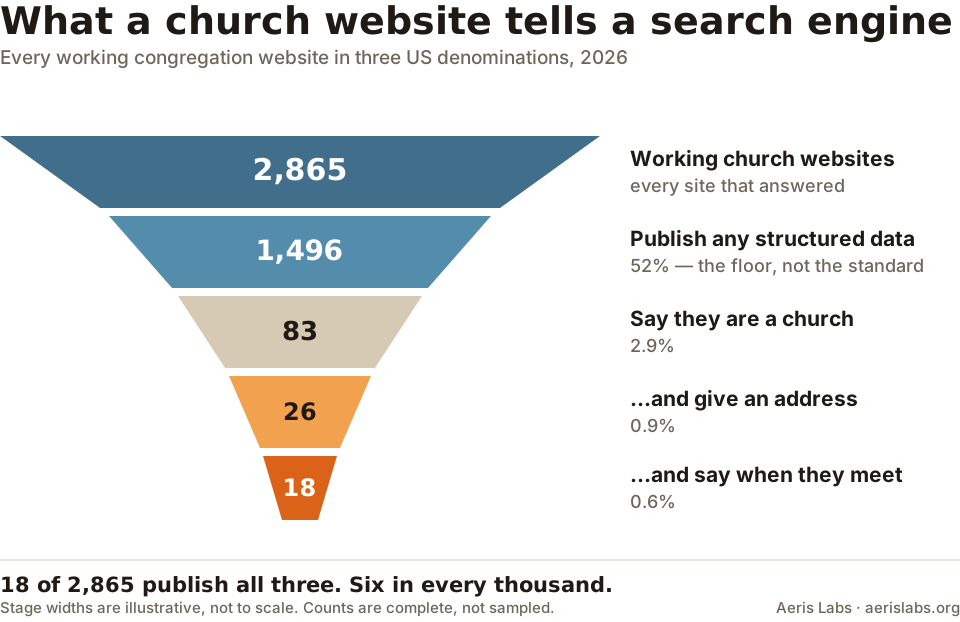
Presence is not usefulness. Of the 1,496 sites publishing anything, 83 identify the organization as a church — 3% of every working site. Nearly all name something, and one in ten of those is not the congregation: an acronym, a bare domain name, in one case the file name of a photograph. 716 carry an address. Only 202 break the address into the four fields a machine needs to drop a pin on a map.
And the platforms fail in opposite directions. Squarespace describes a business, with opening hours, and never says what kind of business: three of its 673 sites name a church, though 68% carry an address. Church.co names a church on 98% of its sites and gives an address on 2%.
Eighteen sites in the entire study publish all three of the things a stranger needs: that this is a church, where it is, and when it meets.
None of this is a character test on the churches. Nobody handed them the list above, and no congregation should be expected to know that search engines want specific fields according to shared standards. The platforms are a different matter. They employ people who work with web technologies for a living and they sell to churches specifically.
That leaves the part a church can act on without waiting for anyone. Most of what this section measured is in the checklist at the end of this study, divided between what a church can check for itself and what belongs to whoever maintains the site.
What four thousand rows look like when you stop averaging.
Here are five unnamed congregations out of the 4,699, chosen because each one stands for a whole category. Every detail is from our own measurements.
The website that was rebuilt and still says 2003
The site runs on a modern church platform, and someone clearly did the work of migrating. The homepage has 249 words on it and publishes no structured data at all. And at the bottom of the page, carried across from whatever came before, the copyright reads 2003. The footer is older than Facebook itself.
Someone cared enough to rebuild. No one looked at the finished thing the way a stranger would.
The website that takes half a minute to answer
It takes thirty-one seconds to deliver thirty kilobytes, a page smaller than a single photograph. Nothing is technically broken, and every automated check counts it as fine, but no one will wait that long.
Across the three studies the median site answers in about a second. A visitor who leaves at ten seconds never appears in anyone's numbers, and the church has no way of knowing they came.
The website with a hundred and four photographs, none of them described
Someone has been taking pictures for years — services, meals, baptisms, mission trips — and putting every one of them on the website. It looks like a labor of love, but not one of the 104 carries a line of alternative text. 102 carry an empty one: the markup that says a photograph does not matter. To a blind visitor, the page is 104 silences.
Thirteen sites in this study carry twenty-five or more images with not a single one described. All that effort, and the last inch of detail is missing.
The church that did everything and is listed as having nothing
Its denomination's directory records no web presence. The congregation has a website that answers in under a second and prints the service times in plain Spanish near the top. It has Facebook, Instagram and X. It has a phone app, a real one in the App Store, built for it in 2024 and updated since. The app has sermons on demand, push notifications, offline downloads, and sharing.
The app and the website run through the same vendor, which publishes no structured dataA small block of code in a page that states what you are, where you are and when you are open, in a form search engines read without guessing. Those facts can then appear in search results themselves, not just a link.Read the full entry →, so those service times are unreadable to a machine.
About a third of the congregations listed as having no website have one. This congregation did everything: website, app, and several active social media accounts. Yet the directory says it did nothing.
And thirty-one regions where none of this happened
Half the regional bodies large enough to measure — thirty-one of them — have no broken links at all: every congregation listed, every address current, every link leading where it says.
They are not smaller: a median of 23 congregations against 25 for the rest, and the same share of churches with no website. A list that clean does not stay clean on its own.
Ten minutes to check your own front door.
Run this twice a year, whether you serve a church or a nonprofit. Every item comes from something we found.
That is what can honestly be asked of a person with other work. It is also the wrong interval for the problem: a domain can lapse the week after you check, and nothing announces it.
The twice-a-year website check
- Open your site in a private browser window. Not your bookmark, not your saved tab: a clean window, the way a stranger arrives. Does it load? Does a warning appear first? A saved copy in your own browser is the single most common reason a broken site goes unnoticed for months.
- Search for your church the way a stranger would. Not your name: your town and the word "church." If you cannot find yourself, neither can the family that just moved in.
- Ask a search engine what it has. Type site: followed by your address, with no space between, into a search box. Back comes every page it holds for you. Nothing at all usually means a single settingA single instruction in a page’s code, or in the reply from its server, telling search engines not to list it. Nothing about the page looks any different, and the page itself goes on working perfectly.Read the full entry → is telling search engines to skip you, and we found forty-two finished sites still carrying it.
- Send yourself a link. Paste your URL into a text message and look at what your phone shows: a picture with a headline under it, or a blue line of text. That preview is what a member hands to a friend when they recommend you, and tags in your pageA few lines of code in a page naming the title, description and image to use when somebody shares your link. Most apps read them to turn a pasted address into a preview card with a headline and a picture.Read the full entry → decide it.
- Count the words on your homepage. A third of the sites we checked carry fewer than two hundred. If a stranger cannot learn what kind of church you are and what a Sunday morning is like, a search engine has no more to work with than they do.
- Check your listing in your denomination's directory. Is the link right? Is it your current address? A third of the churches listed as having no website have one. Directories are generated from records, so a correction usually needs making in more than one place.
- Find your renewal dates. Know when your domain nameThe address people type to reach you, like yourname.com or yourname.org. It is rented, not owned, and renews on a date.Read the full entry → and hostingThe service that stores your website’s files, data and code, and serves pages to visitors. It is separate from the domain name: the domain is the address, the hosting is the building it points to.Read the full entry → expire, and who gets the email when they do. A lapsed domain is the fastest way a church loses its front door. We have watched one come back as a casino link farm, still carrying the search ranking the church spent years earning. An established church domain is worth real money to spammers and scam operators, precisely because search engines still trust it.
- Write down who holds the keys. Which accounts, which passwords, which person, then make sure a second trusted person has them too. This is the whole ballgame.
No one writes it down. Then someone leaves. A single set of keys, in a single pair of hands, and a day that came when those hands moved on.
A few more, for whoever handles the tech
These are the fundamentals we measured, and where most sites fell short.
- Structured data. A small block of schema markupA small block of code in a page that states what you are, where you are and when you are open, in a form search engines read without guessing. Those facts can then appear in search results themselves, not just a link.Read the full entry → naming you as a church, with address and service times, so search engines can show them directly. Missing from nearly half of all sites we checked.
- One headline per page. One clear main heading (an H1The nesting of headings on a page, like an outline: one H1 saying what the page is, H2s for its sections, H3s inside those. Screen readers navigate by that structure, and search engines read it as one signal of what the page is about.Read the full entry →), everything else nested under it. Screen readers navigate by that structure. A third of sites have no main heading at all.
- A written description for search. Each important page needs a single-sentence descriptionA short line you write about a page, offered to search engines to show beneath your title in search results. They write their own if you do not, and often even if you do.Read the full entry →, the line under your name in results. Nearly half of sites had none, so search engines invented their own.
- Describe your images. Four in five sites leave at least one undescribed, most often by shipping an empty alt attribute. It is how a blind visitor experiences your photos and how a search engine reads them.
- HTTPS all the way down. Every image, font and script should load over HTTPSThe secure version of a web connection. It encrypts what passes between a visitor and your site, and browsers stamp "Not secure" on sites that lack it.Read the full entry → too. Miss one resource over HTTP and the whole page stops counting as secure. About a third of the sites we checked make this mistake.
- Make the copyright year update itself. If your platform can always say the current year rather than a fixed year, then you never have to set it again. 348 sites still show 2024 or earlier.
- Name one address as the real one. A canonical addressThe address you name as a page’s real home, stated in the page’s own code, for when the same content can be reached at several addresses. It asks a search engine to treat that one as the original.Read the full entry → tells a search engine which version of a page to treat as the original when several answer. A quarter declare none, so the address a stranger sees may not be the one on your sign.
Some churches have lost their web address. We are not publishing which ones.
Some of those addresses are now being used by other people for other purposes. We know which congregations, and we are publishing neither the number, the list, nor anything that would let a reader reconstruct it. Such a list is exactly as useful to someone looking to exploit it as to someone looking to fix it.
We wrote to each church or its denominational office with the specifics and a suggested fix, before a word of this page existed.
This is the part where we ask for work.
Everything above is yours to use. What follows is not research, so it sits by itself. What we do the rest of the time is on the services page.
If you serve one church
We will run an audit on your website covering over 80 variables across 13 categories, and we’ll send you the results for free. This is far more comprehensive than the 14 variables we checked on the websites in this study.
If your church has no website, or an underperforming one
We can design and build you the kind of website only eighteen of the 2,865 in this study managed: one that tells a search engine what you are, where you are and when you meet, so a stranger looking for a church sees those answers in the results instead of a bare link. Then we host and look after it.
If you keep a directory
We will clean your church directory and help those congregations get found. That means auditing every one and reconciling the list against what is actually out there: dead links, websites you never recorded, churches missing altogether. Every congregation would get its own report on what to fix. We would quote that as a project, and continuous monitoring is an option.
If you build church websites
Finding Five outlines how a handful of vendors could quickly fix most of the problems we found in this study, and their church clients wouldn’t even have to know. We want to see churches served well, even if not by us. We do build our own platform, AerisForge, so no one at a church ever has to know the word schema.
Every minority language figure in this study is a floor.
The language figures in Finding Four come from reading congregation names, and names find the better-resourced churches. One denomination sorts some congregations into language-based regional bodies, which let us check: among those 207, the ones names identify have no website 28% of the time; the ones names miss, 46%. Names report a gap three and a half times the rest of the denomination where the structure shows five and a half.
We wrote a classifier that reads real web page content instead of the names. That method puts the number of language-minority congregations at 566, with a range of 219 to 1,350. The classifier cannot see a church with no page to read, and those are the churches this finding is about.
Congregations are also frequently not one language but two or three, threading between a Korean service and an English one, Spanish preaching and English children’s ministry. A single language label would hide the true nature of the most interesting churches.
Method. Every denomination is measured the same way, so the studies can be pooled. The denominations behind this page are not named. The method is open and set out below; the tooling that runs it — the probe, the extractor, the classifiers — is ours, and is not published.
- The rosters. Each denomination’s national directory is taken in full, in whatever form it publishes. Regional directories are sought as well, and used where one publishes a list a machine can read.
- The count. Every congregation is recorded as listed with a website address or without one.
- The cross-check. Where a regional directory and a national one cover the same congregations, the two are matched church by church, every candidate pair scored and assigned best-first across the whole set rather than greedily.
- The hand search. Congregations recorded as having no website are searched for by hand, across a whole region and a random draw from the rest of the country.
- The fetch. About three requests per site — homepage, robots.txt, sitemap.xml — from a user agent that identifies itself, one page deep. Nothing behind a login is touched and nothing is probed for vulnerabilities.
- The re-test. Every apparent failure is tried a second time with a browser signature and a current certificate root set, and every domain is confirmed against the registries rather than inferred. In these studies about a third came back alive, and none of those are counted as failures. Hosting placeholders, lapsed account notices and empty shells are reclassified by hand.
- The measurements. Every study runs the same probe against one shared definition file, so the figures are comparable and additive.
- The language classification. Three instruments: a name heuristic, which reaches every congregation and is often wrong; a detector reading the homepage and the about page, accurate but blind to congregations with no site to read; and, where a denomination sorts congregations into regional bodies by language, its own classification, treated as ground truth. Detectors are calibrated against a hand-judged sample, with Wilson intervals on every rate.
What the figures cover. Regional figures cover only the two denominations that record a regional body, excluding congregations recorded under none; a body needs at least fifteen listed links to be included. Platform figures exclude 47 sites a detector misread as a commerce platform. No congregation is identified, ranked or scored anywhere in this publication.
The Facebook measurement. The 50 congregations tested are every church in our hand-checked sample found to have a Facebook page and no website of its own. Each page was requested once, signed out, with no browser and no JavaScript engine, the position of most automated visitors, and the plain document any indexer is handed before it decides whether to render. Readable text is what remains after scripts, styles and markup are removed. Facebook's crawling policy was read from its own published instructions to automated visitors rather than characterized from memory.
How the page measurements are defined. Everything read out of a page's HTML comes from one extractor module with a test suite, because several of these terms are contestable and the definition decides the number. A copyright range such as "2010–2026" is read as 2026, since the notice claims currency through that year; a year later than next year is treated as a template fault rather than a claim. Insecure content counts only files a page loads into itself — images, scripts, stylesheets, fonts, CSS backgrounds — and not ordinary links to other sites over http, which do not affect a page's security. Word counts resolve HTML entities first, so spacing characters are not counted as words. A description tag whose content is empty is not a description. An empty alt attribute is treated as the correct markup for a decorative image rather than as a fault, so the reportable defect is an image carrying no alt attribute at all. Page bodies are kept, so any change to these definitions is a recomputation rather than another visit to several thousand churches. A markup name counts as the congregation’s own when at least half its distinctive words match the name in the denominational directory, which is a generous test and will understate the mismatches. The quality figures are measured on the 2,865 sites that answered a second reading; the link, directory and language findings cover all 3,068.
How we identified language. Two denominations publish nothing about the languages their congregations worship in, so for those we read names. One denomination sorts some congregations into regional bodies defined by a shared language, which gave us a known answer to test against: of those 207 congregations, names identify 47. A second instrument reads the sites instead, fetching the about page as well as the homepage, because that is where a church explains who it is. Its rules were built by hand-reading real church sites and correcting what the first version got wrong; the correction that mattered most was weighting foreign-language text by context, since a denomination with a strong missions emphasis is full of English-speaking churches that pray for Ecuador in Spanish. Beside service times or "our congregation" the evidence counts; beside missionary, partner or support it is discounted. Against the same 207, that instrument identifies 65% of the congregations that have a page to read and 26% of the group as a whole. Across the study it flags 233; we then drew a stratified sample across its confidence bands, judged fifty by hand, and projected each band’s error rate back onto its population, giving the calibrated estimate of 566 and the range of 219 to 1,350.
Sources for figures not our own. Facebook usage among American adults: Pew Research Center, Americans' Social Media Use 2025 (National Public Opinion Reference Survey, 5,022 U.S. adults, fielded 5 February – 18 June 2025) — 71% of adults ever use Facebook; and, for daily use, the same report's American Trends Panel survey (5,123 U.S. adults, fielded 24 February – 2 March 2025), in which 52% of adults report visiting Facebook daily: 37% several times a day and 15% about once a day. Independently, 68% of Americans aged 12 and over currently use Facebook — Edison Research, The Infinite Dial 2026, presentation deck, slide 20. Where the two differ we have used the reading least favorable to our own argument. Platform primacy: Edison Research, The Infinite Dial 2026 (national survey of 2,050 Americans aged 12 and over, fielded January 2026) — Facebook is the most-used platform for 40% of social media users and is dominant among those 55 and over. Usage by age band (Facebook 68% / 80% / 74% / 57% for ages 18–29, 30–49, 50–64 and 65+; Instagram 80% and YouTube 95% among 18–29): Pew Research Center, same 2025 survey, tabulated in its social media fact sheet. How people look for a congregation: Pew Research Center, Choosing a New Church or House of Worship (2016), chapter 1, where these figures are tabulated — 37% of those who have looked for a congregation searched online, 47% among those who searched within the previous five years against 26% earlier, 59% among adults under thirty, and 19% who made a phone call. That report is a decade old and we use it for the comparison between channels rather than for the levels. Absence of a congregation-side benchmark: Faith Communities Today, 2020 national survey of 15,278 congregations, which records worship, giving and online-service platforms but does not ask whether a congregation has a website. Church closures and openings: Lifeway Research, Protestant Church Closures Outpace Openings in the U.S. (2021) — an estimated 4,500 Protestant churches closed in 2019 against 3,000 opened, built from congregational data supplied by 34 denominations and groups representing about 60% of U.S. Protestant churches; and Lifeway Research, January 2026 release covering 2024 — 4,000 closed against 3,800 opened, from 35 denominational groups representing 58% of U.S. Protestant churches. Both are estimates assembled from denominational reporting rather than a census, and we use them only to establish that closure is a continuous annual phenomenon, not for any single year. We deliberately do not cite the widely repeated local-search and organic-reach statistics that circulate in marketing material — "46% of searches have local intent," "organic reach has fallen to 2%" — because we could not trace any of them to a published methodology. Where we could not source a claim, we left it out or measured it ourselves.
How this page was written. The prose began as an AI draft. It was then edited by hand and in places rewritten, section by section, across two weeks and several passes: seven published figures turned out to be wrong and were corrected, claims we could not support were cut, and every outside source was confirmed before being cited. The findings, the method and every measurement are our own.
Who ran this study. Rob Hughes has been developing websites since the 1990s, and his career spans positions in technology, ministry and media. He has a B.S. in Mechanical Engineering and an MBA from CSU Sacramento. He holds an Artificial Intelligence and Machine Learning certificate from Caltech and is Snowflake SnowPro certified. He earned a ministry certificate from the Institute of Biblical Studies, Cru, served twelve years with Cru as a full-time missionary, and spent six years on the board of his local church. His article for Telios Law, a firm serving churches and ministries, Are Church Websites Putting Their Organizations at Risk?, draws on this study.
How to cite this study. Hughes, Rob. What a stranger finds when looking for a church: a census of 4,699 congregations across three American evangelical denominations. Aeris Labs LLC, 15 August 2026. aerislabs.org/research/evangelical-church-web-2026
Good tools should outlast the people who build them.
That conviction is the whole idea behind Aeris Labs: websites, software, and durable systems for churches and mission-driven work, built to be inherited, not just shipped.